NIS2 | DORA | Cybersecurity Maturity | Operational Resilience
Protect your business and strengthen its ability to respond to threats promptly and effectively by implementing the appropriate measures.
Ensure the trust of all stakeholders involved: customers, staff, partners, and regulatory authorities.
Cybersecurity determines your business continuity!
From Regulation to Resilience
Organizations across Europe are facing increasing pressure to strengthen cybersecurity, operational resilience, and regulatory compliance.
The growing frequency of cyber threats, combined with evolving European regulatory frameworks such as the NIS2 Directive and the Digital Operational Resilience Act (DORA), is transforming cybersecurity into a strategic business priority.
Today, organizations are expected not only to protect systems and data, but also to demonstrate structured governance, operational resilience, incident preparedness, and regulatory compliance.
The CCR SERVICES PARTNERS PS ALLIANCE (CCR -Cybersecurity Compliance & Resilience) was created to support organizations in understanding, preparing for, implementing, and operationalizing cybersecurity and compliance frameworks through a structured and practical approach that adds value.
The Challenge Organizations Face
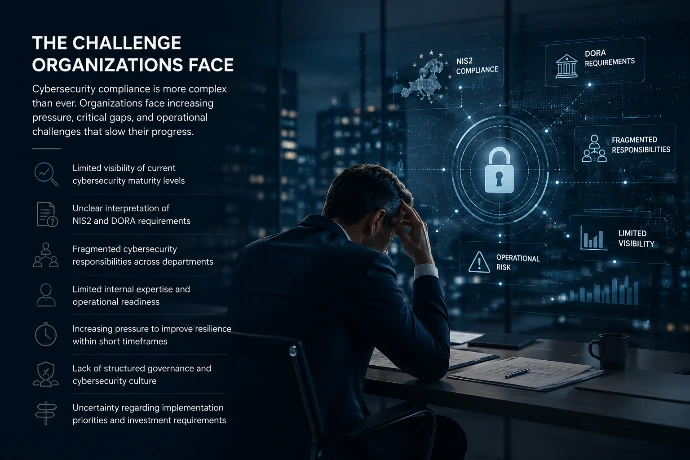
Many organizations understand the importance of cybersecurity compliance, yet struggle with practical implementation and organizational integration.
Common challenges include:
Limited visibility of current cybersecurity maturity levels
Unclear interpretation of NIS2 and dora requirements
Fragmented cybersecurity responsibilities across departments
Limited internal expertise and operational readiness
Increasing pressure to improve resilience within short timeframes
Lack of structured governance and cybersecurity culture
Uncertainty regarding implementation priorities and investment requirements
At the same time, organizations must protect:
Operational continuity
Digital infrastructure
Sensitive business and customer data
Business reputation and stakeholder trust
Regulatory compliance and accountability
Cybersecurity today is no longer only a technical issue. It is a business continuity and organizational resilience priority.
It is a priority for business continuity and organizational resilience.
Organizations today are called upon to prepare their workforce for increasingly complex operational environments, while maintaining high levels of security, efficiency, and regulatory compliance.
As operational risks increase and technological advancements accelerate, organizations need more effective and scalable cybersecurity solutions.
The Strategic Opportunity
Organizations that approach cybersecurity strategically can transform compliance from a regulatory obligation into a long-term operational capability.
A structured cybersecurity and resilience framework enables organizations to:
Strengthen operational resilience
Reduce cyber risk exposure
Improve governance and accountability
Improve incident response preparedness
Strengthen customer and stakeholder trust
Support secure digital transformation
Align with european cybersecurity and operational standards
Cybersecurity maturity is becoming a critical component of sustainable and resilient business operations.
Cybersecurity Governance
Cybersecurity governance frameworks
Board and executive accountability
Cybersecurity strategy
Policies and procedures
Risk management
Governance structures
Decision-making frameworks
Cybersecurity culture
Leadership awareness
+
Cybersecurity Compliance
NIS2 readiness
DORA readiness
Gap assessments
Compliance frameworks
Audit preparation
Documentation
Controls alignment
Regulatory reviews
Reporting readiness
+
Cybersecurity Operations
Operational resilience
Incident response
Operational readiness
Monitoring
Continuity planning
Recovery planning
Operational controls
Awareness and training
Operational cybersecurity procedures
+
Who We Support
The CCR SERVICES PARTNERS PS ALLIANCE supports organizations that:
Are subject to NIS2 or DORA requirements
Operate in regulated or critical sectors
Manage sensitive operational or customer data
Are investing in digital transformation initiatives
Require structured cybersecurity implementation support
Seek to strengthen operational resilience and governance
We help organizations develop and maintain their Cybersecurity Maturity Level through a sustainable approach, ensuring their resilience and business continuity.
Typical sectors include:
Organizations operating in the financial sector are increasingly exposed to cybersecurity, operational resilience, and regulatory compliance requirements due to their dependency on digital systems, data processing, interconnected infrastructures, and critical operational continuity.
Typical organization types include:
Banks and credit institutions
Investment firms
Insurance companies
Payment service providers
Fintech companies
Electronic money institutions
Financial technology platforms
Financial data processing providers
Financial outsourcing and support providers
These organizations typically handle:
Sensitive financial and customer data
Digital transactions and payment systems
Interconnected operational platforms
Critical financial services infrastructure
High-volume data exchange environments
NIS2 related cybersecurity priorities often include:
Cybersecurity governance and accountability
Incident response preparedness
Operational resilience frameworks
Supply chain cybersecurity management
Business continuity and disaster recovery planning
Continuous monitoring and risk management
Healthcare organizations operate in environments where cybersecurity incidents can directly affect patient safety, operational continuity, medical systems, and access to critical healthcare services.
Typical organization types include:
Hospitals and clinics
Medical centers
Diagnostic laboratories
Healthcare networks
Pharmaceutical organizations
Telemedicine providers
Healthcare technology providers
Healthcare data management organizations
Medical equipment service providers
These organizations typically handle:
Electronic medical records and patient systems
Interconnected healthcare infrastructureς
Medical and operational technologies
Continuous access to digital healthcare services
Sensitive health and personal data
NIS2 related cybersecurity priorities often include:
Protection of critical healthcare infrastructure
Ransomware preparedness and response
Medical systems security
Access control and data protection
Operational continuity during incidents
Cybersecurity awareness for healthcare personnel
Professional services organizations increasingly manage sensitive customer, legal, operational, and financial information through highly digital and interconnected environments.
Typical organization types include:
Accounting and audit firms
Legal firms
Consulting companies
Engineering and technical consultancies
Business advisory firms
Digital service providers
Outsourcing and managed service providers
Cloud and IT support organizations
These organizations typically handle:
Confidential client information
Operational and business-critical data
Cloud-based collaboration systems
Digital communication environments
Third-party and supply chain access
NIS2 related cybersecurity priorities often include:
Governance and compliance controls
Third-party cybersecurity management
Secure information management
Identity and access management
Employee awareness and phishing protection
Operational continuity and backup procedures
Transportation and logistics organizations depend heavily on digital coordination systems, operational continuity, infrastructure connectivity, and real-time information exchange.
Typical organization types include:
Logistics providers
Transportation companies
Freight forwarding organizations
Shipping and maritime operators
Warehouse and distribution centers
Fleet management organizations
Supply chain coordination platforms
These organizations typically handle:
Operational coordination systems
Real-time logistics and tracking platforms
Interconnected transportation infrastructure
Digital communication environments
Operational continuity across multiple locations
NIS2 related cybersecurity priorities often include:
Operational resilience and continuity
Protection of transportation infrastructure
Supply chain cybersecurity
Incident detection and response
Secure communications and operational systems
Risk management across distributed environments
Energy and utilities organizations form part of critical national infrastructure and are considered high-priority sectors under NIS2 due to the potential operational and societal impact of cybersecurity incidents.
Typical organization types include:
Electricity providers
Renewable energy organizations
Water supply organizations
Utility infrastructure operators
Energy distribution networks
Operational technology providers
Smart infrastructure operators
Industrial energy management organizations
These organizations typically handle:
Critical operational infrastructure
Industrial control systems (ICS)
Operational technology environments (OT)
Smart utility systems
Interconnected national infrastructure
NIS2 related cybersecurity priorities often include:
Critical infrastructure protection
OT and ICS cybersecurity
Operational continuity and resilience
Incident response coordination
Governance and risk management
Supply chain and third-party cybersecurity
Industrial and manufacturing organizations increasingly rely on digital manufacturing systems, automation, interconnected operational technologies, and smart production environments.
Typical organization types include:
Manufacturing companies
Industrial production facilities
Automated production plants
Food and beverage manufacturers
Industrial equipment operators
Smart factory environments
Industrial supply chain organizations
Production and processing facilities
These organizations typically handle:
Industrial automation systems
Operational technology environments
Connected manufacturing infrastructure
Production continuity
Industrial monitoring and control systems
NIS2 related cybersecurity priorities often include:
Protection of production operations
OT and industrial cybersecurity
Operational continuity and resilience
Ransomware preparedness
Industrial supply chain cybersecurity
Incident detection and recovery planning
Industrial and manufacturing organizations increasingly rely on digital manufacturing systems, automation, interconnected operational technologies, and smart production environments.
Typical organization types include:
Manufacturing companies
Industrial production facilities
Automated production plants
Food and beverage manufacturers
Industrial equipment operators
Smart factory environments
Industrial supply chain organizations
Production and processing facilities
These organizations typically handle:
Industrial automation systems
Operational technology environments
Connected manufacturing infrastructure
Production continuity
Industrial monitoring and control systems
NIS2 related cybersecurity priorities often include:
Protection of production operations
OT and industrial cybersecurity
Operational continuity and resilience
Ransomware preparedness
Industrial supply chain cybersecurity
Incident detection and recovery planning
Small and medium-sized enterprises (SMEs) and growing organizations are increasingly targeted by cyber threats while often lacking structured cybersecurity governance, dedicated expertise, and operational resilience frameworks.
Typical organization types include:
Growing SMEs
Digital-first businesses
Scaling enterprises
Technology-enabled organizations
Professional and operational SMEs
Expanding service providers
Export-oriented businesses
Organizations participating in digital transformation initiatives
These organizations typically face:
Limited cybersecurity resources
Increasing digital dependency
Evolving compliance obligations
Operational and reputational risk exposure
Supply chain cybersecurity requirements
NIS2 related cybersecurity priorities often include:
Cybersecurity maturity assessments
Governance and accountability structures
Cybersecurity awareness and training
Operational resilience improvement
Incident preparedness and recovery planning
Scalable cybersecurity implementation frameworks
The structured approach of CCR SERVICES PARTNERS PS ALLIANCE
The CCR SERVICES PARTNERS PS ALLIANCE combines cybersecurity expertise, consulting, organizational transformation, implementation support, and capability development.
Our approached is based on 3 basic pillars of services:
3 pillars of services
1
Cybersecurity & Compliance Discovery
Cybersecurity maturity assessments
NIS2 and DORA gap analysis
Operational and governance review
Risk exposure identification
Opportunity discovery workshops and cybersecurity and resilience prioritization
Outcome:
A clear understanding of the organization’s current situation, risks, priorities, and required actions.
Compliance implementation suppor and audit preparation support
Organizational change management
Outcome:
Structured and scalable cybersecurity implementation aligned with operational realities.
3
Training, Awareness & Capability Development:
Cybersecurity awareness programmes
Executive and management workshops
Operational cybersecurity training
Organizational resilience development and continuous improvement frameworks
Funding programme advisory and application support
Outcome:
Improved awareness, operational preparedness, and long-term organizational resilience.
The value that your organization gains
Cybersecurity Maturity Assessment
Assessment of the organization’s cybersecurity posture, governance structure, operational readiness, and compliance maturity.
Reduced exposure to cybersecurity threats
Identify vulnerabilities, prioritize critical risks, and implement structured cybersecurity measures that reduce the likelihood and impact of cyberattacks.
Structured and scalable implementation
Adopt cybersecurity and compliance frameworks through a practical and scalable implementation approach tailored to your organization’s operational needs.
Readiness Assessment
Evaluation of organizational alignment with NIS2 and DORA requirements and identification of priority compliance gaps.
Improved governance and accountability
Enhance decision-making, cybersecurity oversight, and accountability through clearly defined governance structures, policies, and responsibilities.
Increased trust from customers, partners, and regulators
Demonstrate your commitment to cybersecurity, business continuity, and compliance, enhancing the credibility and trust of stakeholders.
Stronger business resilience
Enhance your organization's ability to maintain critical functions, respond effectively to incidents, and recover from disruptions with greater stability and confidence.
Increased organizational readiness and awareness
Empower staff awareness, operational readiness, and cybersecurity culture through targeted training and awareness programs.
Enhanced Business Continuity and Incident Management Readiness
Improve your organization's ability to detect, manage, and recover from cybersecurity incidents, minimizing operational impacts and downtime.
"Cybersecurity is much more than a matter of IT." - World Economic Forum
"Cybersecurity is ultimately about people, not technology." - Emsisoft
"If cybersecurity isn’t on the board calendar, it won’t get the attention it deserves." - Colin Low
Start a structured discussion with us
Every organization faces different cybersecurity realities, operational risks, and compliance priorities.
We begin with a structured exploratory discussion to:
Understand your organization's current state
Identify operational gaps and compliance deficiencies
Assess cybersecurity priorities
Examine practical implementation options
Identify potential funding opportunities
Let's explore how we can strengthen your organization's cybersecurity, compliance, and resilience.
Complete the form below and a PARTNERS PS consultant will contact you to arrange a short discovery meeting to assess your organization's cybersecurity, compliance, and business resilience needs.
We are always eager for your best service!
We use cookies to provide you a better user experience on this website.Cookie Policy